

4 min read
Canadian media consumption continued to shift throughout 2025-26, shaped by major cultural moments, evolving platform choices, and changing consumer behaviour. From headline-making sports events that drove television audiences, to the growing mix of streaming, social and audio consumption, Canadians continued to move across platforms rather than rely on a single medium.
Using insights across Numeris solutions, this Year in Review looks at the moments that captured attention, how audiences chose to engage with content, and how advertisers responded. Together, the data provides a broader view of how Canadian media behaviour evolved across 2025-26, from what Canadians watched and listened to, to where brands showed up and what mattered most to consumers.
How Major Television Events Shaped the Year
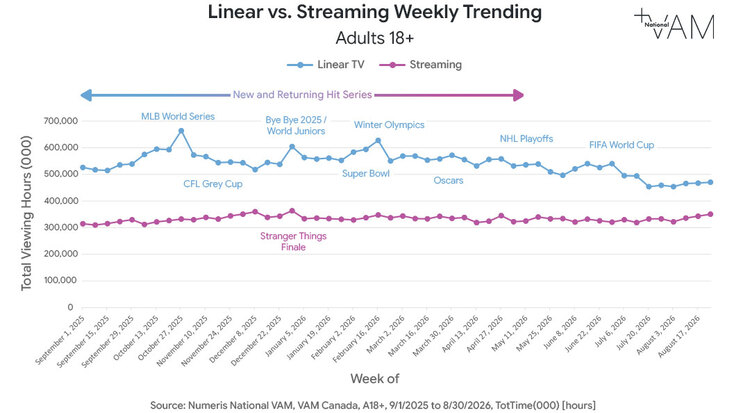
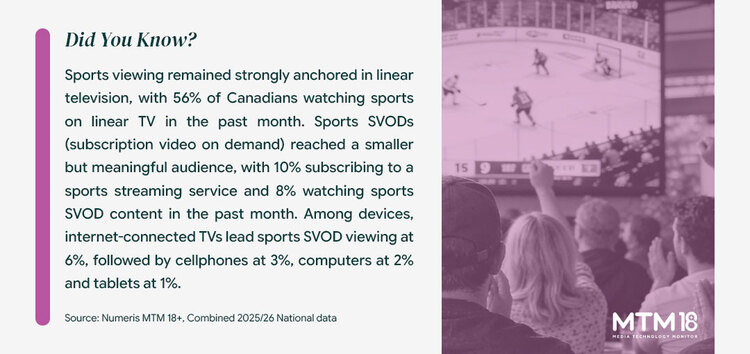
Major events and popular hit series both played a clear role in shaping television viewing throughout the year. Sports moments, such as the MLB World Series, CFL Grey Cup, NFL Super Bowl, Winter Olympics, NHL Playoffs, and FIFA World Cup created some of the most visible shifts in overall viewing, while new and returning hit series helped sustain audiences through the traditional fall and winter seasons. Programs such as High Potential, Chanteurs masqués, STAT, Indéfendable, 9-1-1, The Amazing Race Canada, Survivor, and La Voix were among the titles contributing to conventional television viewing during these periods.
Game 7 of the World Series on Sportsnet was the highest-rated program nationally, while SRC’s Bye Bye 2025 was the top-rated program in Quebec Franco.
Canada’s Streaming Landscape
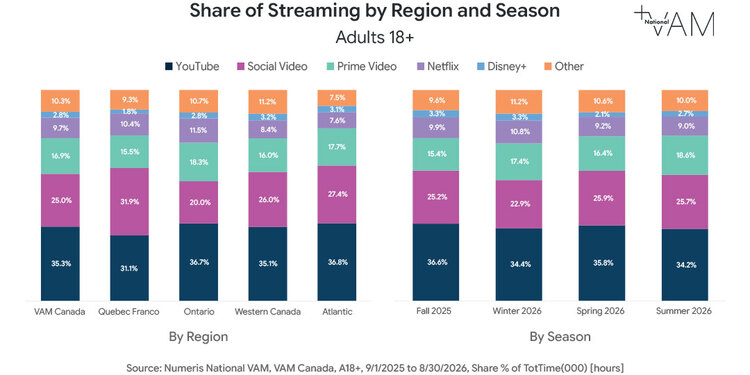
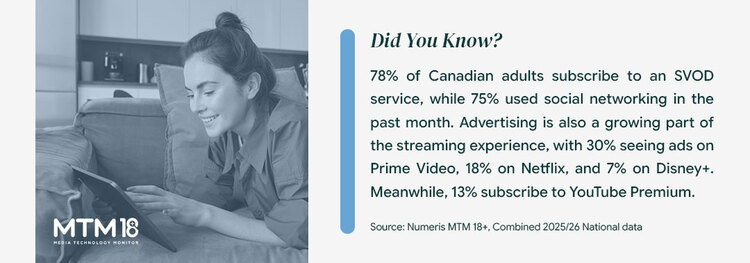
YouTube remains the largest source of streaming nationally, accounting for 35% of viewing, but regional differences highlight how platform preferences vary across Canada. Social video, which includes TikTok, Instagram Reels, Facebook Video, and Snapchat, is especially strong in Quebec, where it accounts for nearly one-third of streaming, while YouTube is strongest in Ontario and Atlantic Canada, at around 37%. Prime Video and Netflix hold a larger share in Ontario compared to the rest of the country while Western Canada closely mirrors the national streaming mix, with similar shares across YouTube, social video, and Prime Video.
Across the year, the streaming mix remains relatively stable. Prime Video shows the clearest upward trend, increasing from 15% in the fall to 19% by summer. Netflix records its strongest share in winter at 11%, consistent with increased viewing around the final season of Stranger Things. Social video dips in winter before rebounding later in the year, while YouTube continues to account for roughly one-third of streaming across all four seasons.
Radio Formats Through the Year
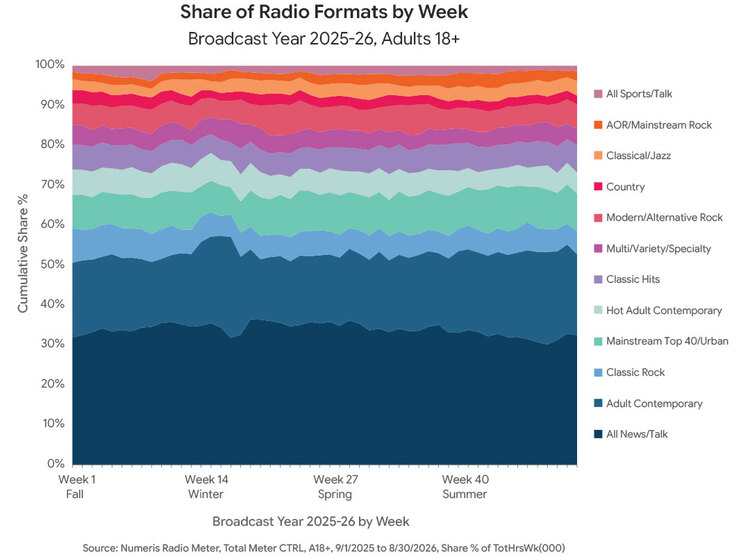
Radio listening remained relatively stable throughout the 2025-26 broadcast year, with the overall format mix showing modest movement from season to season. All News/Talk maintained the largest share of listening throughout the year (32%), followed by Adult Contemporary (18%). The consistency of the mix shows that while individual formats experience seasonal shifts, Canadians’ broader radio habits remain remarkably steady.
Different Formats, Different Audiences
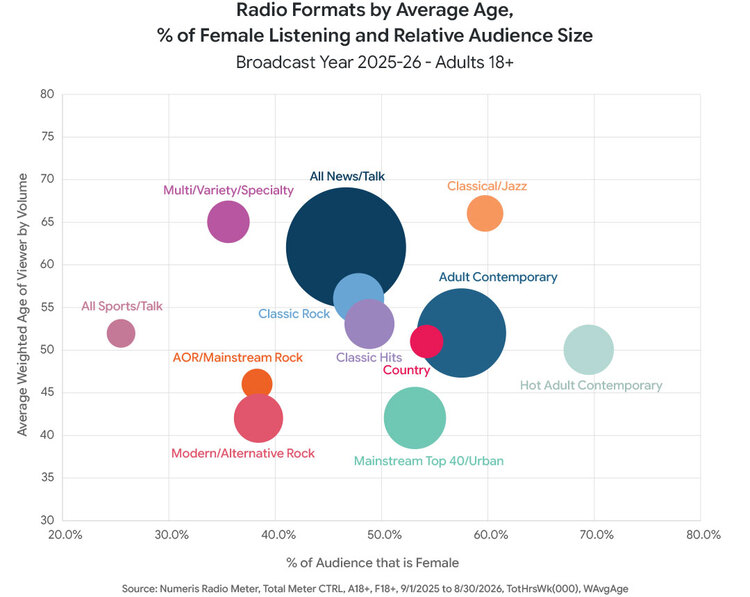
Looking beyond audience size reveals distinct demographic profiles across radio formats. All News/Talk combines the largest relative audience with an older listener profile, while Adult Contemporary has a stronger female audience. Hot Adult Contemporary is the most female skewing of all formats, while All Sports/Talk has the strongest male skew. At the younger end of the spectrum, Mainstream Top 40/Urban and Modern/Alternative Rock attract some of radio’s youngest audiences, demonstrating how different formats continue to reach distinct groups of Canadians.
How TV Advertising Changed Throughout the Year
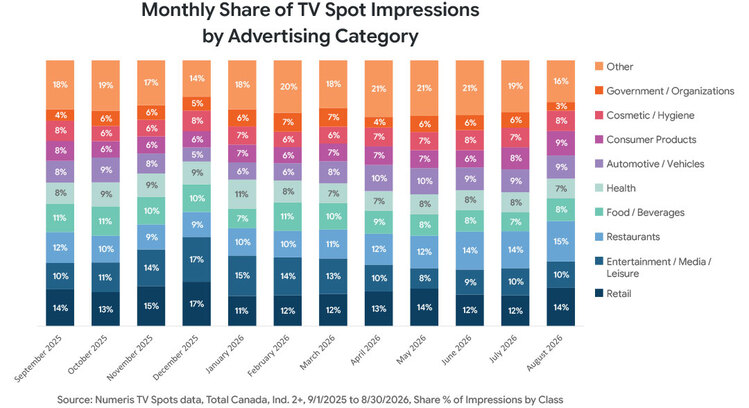
Advertising activity shifted throughout the 2025-26 broadcast year. Retail and Entertainment, Media, and Leisure categories took a larger share heading into the holiday season, with each accounting for about 17% of TV spot impressions in December. Brands such as The Brick, Sleep Country, and Wayfair showed increasing activity through November and December.
Entertainment activity followed a similar pattern. CraveTV advertising built substantially through November and December, coinciding with increased promotion around new and returning series including Heated Rivalry, Project Runway Canada, Canada’s Drag Race, Shoresy and The Pitt.
The story then changes after the holidays. Health advertising represented a larger share in January at 11%, consistent with the winter cold and flu period, with brands such as Advil, Vicks, and Mucinex showing significant activity around this time. Automotive/Vehicles grew through the spring, accounting for around 10% of impressions in April and May, alongside increased activity from Ford, Toyota, and Hyundai.
By summer, Restaurants represented an increasingly large proportion of TV advertising, rising to 14% in June and July and 15% in August, with Tim Hortons, McDonald’s, DQ, and Subway among the most active brands. The FIFA World Cup added another major advertising moment to the summer season, with strong activity from brands such as McDonald’s and Coca-Cola complementing the broader increase in Restaurant and Food/Beverage advertising.
How Radio Advertising Shifted Throughout the Year
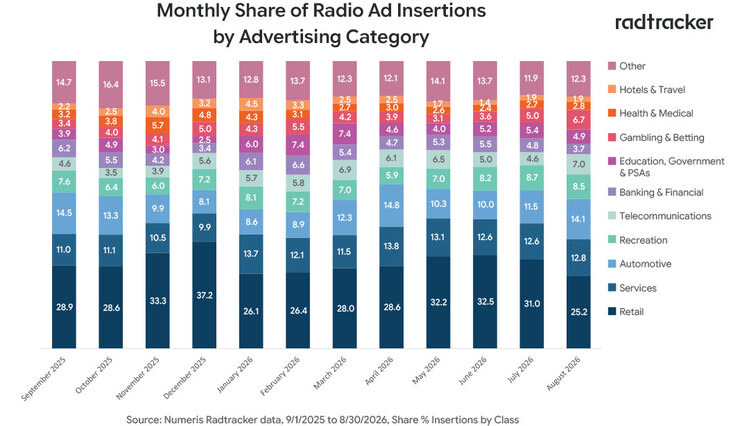
Radio advertising followed a distinct seasonal rhythm throughout 2025-26. Retail became especially prominent heading into the holidays, rising from 33% in November to 37% in December, with increased activity from brands including Spence Diamonds, Shoppers Drug Mart, Sleep Country, Indigo, and Sephora. After the holidays, Hotels & Travel recorded its largest share in January at 4.5%, supported by increased advertising from SellOffVacations, Sunwing, and Air Transat as winter travel activity picked up.
Government and public-sector advertising then became more prominent through late winter, with Education, Government, and PSAs accounting for more than 7% of insertions in both February and March, driven in part by increased activity from the Government of Canada and provincial governments. Automotive followed with a strong spring, representing nearly 15% of radio insertions in April, alongside increased activity from Toyota, Ford, Subaru and other automotive advertisers.
By summer, the mix shifted again. Recreation represented more than 8% of insertions from June through August, while Telecommunications climbed to 7% in August, supported by stronger activity from Bell, Crave, Freedom Mobile, Koodo and Fido. Gambling & Betting also recorded its largest share in August at nearly 7%, with increased advertising from FanDuel, lottery organizations and casino brands.
Buying Canadian Gains Momentum, Especially Among Younger Canadians
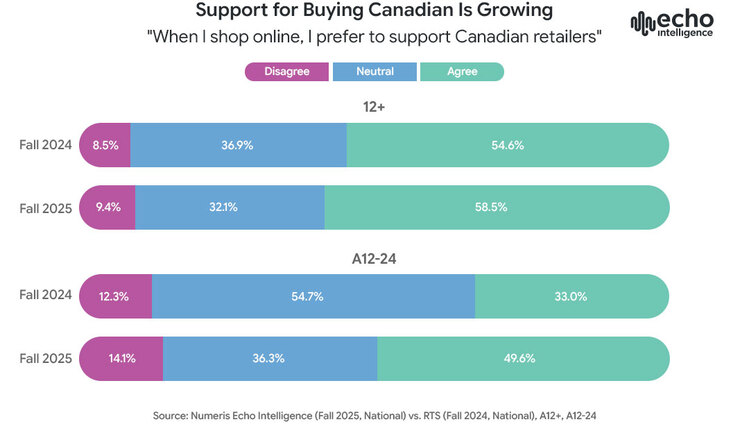
Echo Intelligence data shows that support for buying Canadian strengthened in Fall 2025, with 58.5% of Canadians aged 12+ agreeing that they prefer to support Canadian retailers when shopping online, compared with 54.6% a year earlier. The change was especially notable among Canadians aged 12-24, where agreement climbed from 33% to nearly 50%. This shift came during a period of heightened Canada-U.S. trade tensions, including new U.S. tariffs on Canadian goods and Canadian counter-tariffs, which helped put greater public attention on supporting Canadian businesses and products. With Canada-U.S. tensions continuing to evolve, how might these attitudes shift in Fall 2026? Stay tuned, as the next Echo Intelligence survey will be released soon!
Together, Numeris’ suite of data and solutions provides the broadest picture of Canadian media behaviour, connecting what audiences watch, listen to, and stream with how consumers think, act, and respond to advertising. By bringing video, audio, consumer behaviour and ad tracking insights together, Numeris helps the industry see the full media landscape more clearly and make more informed decisions in a constantly evolving marketplace.
Video: InstarVAM, Video Planner, OneLook, and VAM Insight Tool
Audio: InstarRadio and Lens for Radio
Consumer Behaviour: MTM and Echo Intelligence
Ad Tracking: Spots Monitor and Radtracker