

2 min read
Summer changes the rhythm of everyday life. Longer days, road trips, patios and more time spent out and about all shape how Canadians move through the season, and radio continues to go along for the ride.
This Summer 2026 snapshot looks at how much time Canadians spent with radio, where listening happened, how habits shifted from weekdays to weekends, and the growing role of live radio streaming.
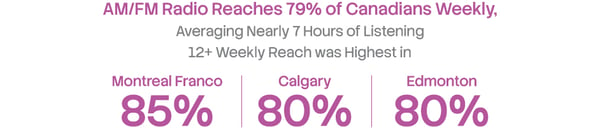
Canadians Stay Tuned in Through the Summer
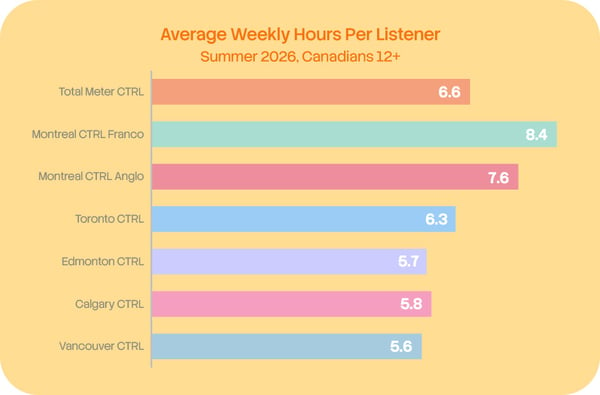
Radio remained a consistent part of Canadians’ weekly routines in Summer 2026, with listeners 12+ spending an average of 6.6 hours per week tuning in. Montreal Franco listeners led the charge at 8.4 hours per week, followed by Montreal Anglo listeners at 7.6 hours, up 4% year over year. Calgary also saw growth, increasing 2% to 5.8 hours, while Vancouver remained stable at 5.6 hours per week. Overall, the results point to strong and sustained radio engagement, particularly in Montreal.
Radio Keeps Canadians Connected on the Go
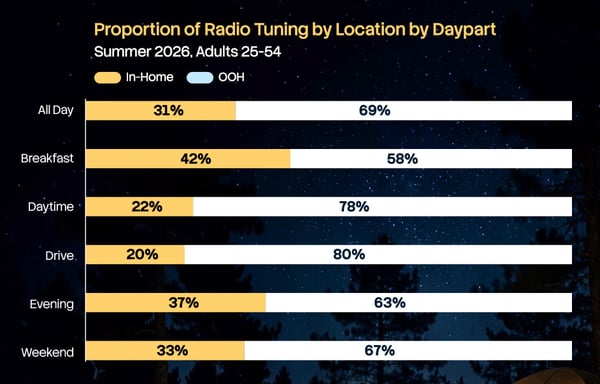
Summer listening took radio beyond the home. Among Adults 25–54, 69% of radio tuning happened out of home this summer, rising to 78% during the daytime and 80% during drive time. Weekend listening followed the same pattern, where more than two-thirds of tuning took place out of home. Whether commuting, heading to the cottage, running errands or enjoying a summer road trip, radio continues to travel with listeners throughout their day.
Weekday and Weekend Listening Follow Different Rhythms
The biggest shifts throughout the day came from out-of-home listening, while in-home tuning is comparatively steady. On weekdays, both rise quickly in the morning, with in-home listening reaching its high around 7:30 a.m., but the much larger out-of-home audience drives the overall morning peak. After breakfast, in-home listening settles into a relatively consistent level throughout the day, while out-of-home tuning builds again through the afternoon and peaks around 5 p.m. and drops steadily after that.
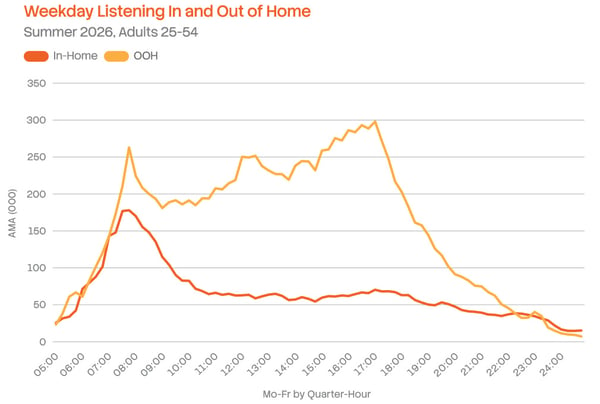
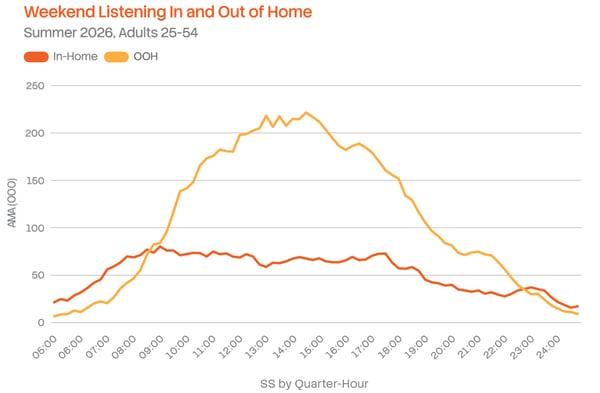
Weekends told a different story. In-home listening builds gradually through the morning and remains consistent from about 9 a.m. through late afternoon. Out-of-home listening continues to grow well beyond the morning, becoming the dominant source of listening and reaching its strongest levels from roughly noon to 4 p.m. Overall, in-home provides a steady base, while out-of-home listening creates the biggest peaks and the greatest variation throughout the day.
Summer Tuning Shifts Across Major Markets
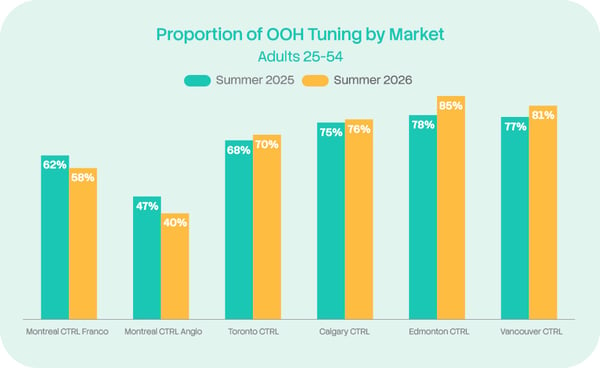
Out-of-home radio tuning gained momentum across most major markets this summer. Edmonton led the way, with 85% of tuning happening out of home, up 7 percentage points from Summer 2025. Vancouver climbed 4 points to 81%, while Toronto rose 2 points to 70% and Calgary edged up to 76%. Montreal moved in the opposite direction, but the broader trend shows radio increasingly travelling with listeners as they commute, get outside, and make the most of summer.
AM/FM Live Radio Streaming* Added Momentum to Summer Radio
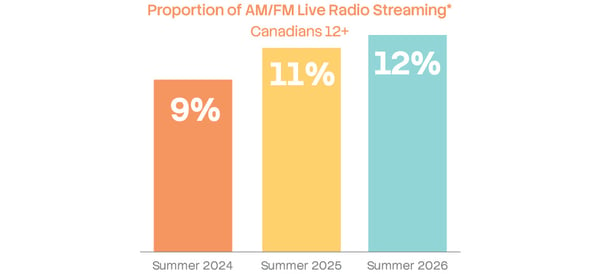
AM/FM live radio streaming* continued to gain ground in Summer 2026, accounting for 12% of AM/FM tuning among Canadians 12+, up from 9% in 2024 and 11% in 2025. Streaming levels were similar across other major demos, with Adults 18–34 and Adults 25–54 slightly higher at 13%.
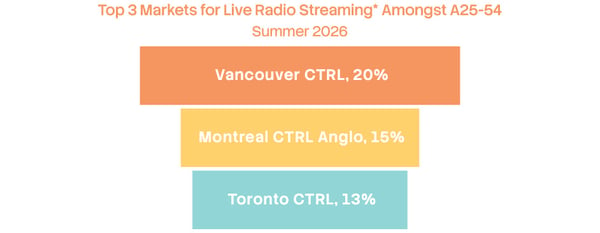
Among Adults 25–54, Vancouver had the highest share of live radio streaming at 20%, followed by Montreal Anglo at 15% and Toronto at 13%, highlighting some notable differences across major markets.
Source: Numeris Radio PPM, Total Meter CTRL, Summer 2026 (Weeks 40-52), Mo-Su 2a-2a, 12+/A18-34/A25-54, AMA(000), AvWkCume(%), AvHoursWk(Lis) *Disclosure: AM/FM Live Streaming includes listening on personal computers, smartphones, tablets, smart speaker, etc. The Numeris radio meter service measures the internet stream of member stations separate from their over the air signal. The live internet stream is identical in programming content.